Saturday, August 1, 2015

A DOG AND HIS MAN:

The Literary Adventures of Chet and Bernie


My love affair with Chet and Bernie began in 2009 with the book Dog On It. It was the first in a series that became known as the "Chet and Bernie Mysteries." There are now 8 books in the group, all written by Spencer Quinn, a mild mannered Cape Codder with a knack for mystery writing, who also happens to be a dog lover.
Bernie Little is a small time private eye, who is also a wounded war veteran. Chet is, well, a dog. Together that make up one of the best crime solving teams in literary history. Chet is basically just happy to be with Bernie, riding shotgun in the Porsche as they go after the perps. Chet loves chew strips and bacon, and most of the food that Bernie likes. Eating is one of his hobbies. But no one brings the bad guys to heel like Chet, who loves to sink his teeth into their pant legs, and even their skin. In the course of a typical C&B novel, the team usually gets separated, and they spend a lot of time trying to find each other again. And of course they do, usually just in time to catch the criminals.

Mr. Quinn does not base Chet on any one dog, but here is a fan's impression of what she thinks the real Chet might look like. Thanks to Anna Trodglen for the fine work of art.
The series has drawn praise from many critics. About Dog On It, famous author Stephen King said:
"Spencer Quinn speaks two languages - suspense and dog - fluently. Sometime funny, sometimes touching, and in a few places terrifying...an enchanting one-of-a-kind novel, A canine Sam Spade full of joie de vivre."

Author Quinn has been spotted with some other possible Chet role models:
                                                             Spencer with Sadie.

                                                     Spencer with Audrey and Pearl
                                                    
                                                        2010: Chet & Bernie mystery #2


                                                        2011: Chet & Bernie mystery #3


                                                        2012: Chet & Bernie mystery #4


To me, Chet is the hero of all of the stories. He makes me want to go out and get a dog! He sizes up people expertly. He knows who's good (those who give him treats and pat him on the head) and who to avoid (those that ignore him or are mean to Bernie). He gets anxious when Bernie goes for his gun, and he tries to get the perps his own way so Bernie won't have to shoot anyone (or get shot at!). Their teamwork is akin to that of Holmes and Watson or the Lone Ranger and Tonto. They always get their man (or woman). As Chet says frequently, Bernie is the smartest guy in the room. No one gets away with anything.

Don't ask me to pick a favorite among these titles.

Praise for them is plentiful:

A detective, a dog, and some major league prose. These books are a genuine joy. 
- Robert B. Parker

If you had a tail, you'd wag it all the way through Quinn's amusing, enchanting, unique stories. 
-Richmond Times-Dispatch

Nothing short of masterful.
-Los Angeles Times


Chet's best friend is Iggy, the poodle who lives next door. Iggy is confined to the house with an electric fence after she and Chet got into some big trouble. But she still barks through the window whenever she sees Chet, and he waggingly returns the greeting. Iggy is so popular she has inspired her own e-book short story:

Iggy's fans also create some unique Iggy items, like Iggy cupcakes! Chet says "yum!"
There have also been some Chet & Bernie e-book short stories:


   And the novels roll on!   
 
2013: Chet & Bernie mystery #5  
 

     2014: Chet & Bernie mystery #6     

                                                       2015: Chet & Bernie mystery #7                                               


 Chet's fans often see him in strange places, like in the clouds!


 Spencer was inspired to create another team: Bowser and Birdie!

 A great many more details about Chet and Bernie may be found at their website:
                                                www.chetthedog.com
And their Facebook page:
                                https://www.facebook.com/ChetTheDog?fref=ts

Chet's blog is contained in his website:
I hope I've whet your literary appetite to get to know Chet and Bernie. I think you will enjoy the time you spend with them.
Bernie promises to cut back on his boozing while you are reading, and Chet just wants you to love him!
Now I have to go get started on novel #8. Sometimes life is good.
Woof! Woof! 
          -Chet


Thursday, July 9, 2015

THE GREAT CATCH, or
A SHORT HISTORY OF MY HONORS CAREER

In the summer of 1989, my unofficial part-time occupation was first baseman for Charlie & Doug Auto Service, in Norwich, Connecticut's "Jack Benny League." I had played on this team for many years, with several players having grown out of the crew at Grant City, where for a few years I was the Sporting Goods Manager. The store is gone now (company bankruptcy), but the memories of the crew linger on. After all, I met my wife there!

Before I get to the "great catch" part, I should briefly cover the few awards I ever received in my lifetime. The first were in the summer of 1962, the year after Mantle and Maris had their legendary pursuit of Babe Ruth's 60 home run record (Maris won, with 61, but is still not in the Baseball Hall of Fame!). I was one of the founders and star players of a ragged group of kids who called themselves the Whetstone Sluggers. My good friend Jim Harvey was the captain of the team, and he and I challenged each other to a home run race. Along with my cousins Bobby McLellan, Clive and Susan West, Stuart and Allan Perkins, Bobby Clemick, and the great Paul Just, we dug out a diamond in a field that belonged to fellow Whetstoner Mr. Mills. (Whetstone I should mention is a pond in central Maine.) That took up a big chunk of the first part of the summer. As our season progressed, cousin Bob suggested we keep track of batting averages, because (as he correctly realized) no one beyond Jim and myself had a shot at the home run title, as we were the oldest of the bunch.
Although these old guys are hard to read, they tell the tale of my incredible achievements in taking both the home run and batting titles. The wooden plaques were crafted by Jim's father, Lawris Harvey, one of our greatest supporters. They were presented to me at our end of summer awards ceremony. As I recall, I logged 52 homers, that crossed a fish line about 200 feet from home plate. At the time it seemed a great feat.

My next moment in the sun came in June of 1963 at my junior high graduation awards ceremony, where I took the "Excellence In History" medal from the Daughters of the American Revolution. I must admit the competition was not remarkable, as my classmates had ignored the rules of the contest, which stipulated that the essays had to cover famous events in Connecticut history. They decided to write about famous people, and were summarily disqualified. It's very possible that their essays were superior to mine (an uninspired treatise on the state's Charter Oak tree), but bottom line is I won! I also grabbed a couple of English prizes, but this great day would have to tide me through the next 8 years of my education, which were apparently not award worthy.

Okay, enough back story bragging. On to that great day in 1989 when I momentarily rose to the top of the Charlie & Doug hero list. Adding luster to the day was the fact that my parents were in the grandstand to observe my moment in the sun. Ironically, this was the one and only time they ever came to watch me play in any game. They had missed my childhood sports escapades and now had to settle for a 40 year old son obviously in the twilight of a less than spectacular softball career.
Here's a look at the team. Since I can only remember a few of the names, I will mention none.  Oh, all right, I will point out Charlie (front row, second from right) and Doug (back row, far right).
That's me: far left in the top row. Here's another shot of a younger team that features our cheerleaders.
That's  my wife, Lorie, front row, third in from the right. I am back row, second from right.
Anyway, at first base, I took note of an opposing player, a left hander, who seemed to enjoy smoking line drives down the right field line. I decided to lay in wait for him, and in the 5th inning he steamed one again, this time in foul territory. But because I was prepared, I lunged across the line and nabbed it. It was a great play, and right in front of my parents, who cheered. One of the few times in my life that I knew my father was proud of me. Here I'll re-enact my lunge for the camera.
Well, I guess you had to be there. Anyway, the game's announcer gave me some vocal praise, and he told us later that it was the finest fielding play he had ever seen. Which translated into my appearance at an end of season awards ceremony where they actually gave me a trophy that reads "outstanding fielding achievement." The other trophy was presented to each of us for our winning the Jack Benny League title. That one actually has my name on it, too. I should mention that my daughter was there to witness the award ceremony. It made the entire episode complete, with my parents there to witness the catch and my daughter there to witness my award.

Okay, that's more excitement than most of you can probably handle. I'll leave you with just one more shot of the glove that did the deed. I can barely get it on my hand today, but I will never part with it.
God bless Mickey Mantle and Roger Maris, who enlivened so many young boys' lives, including mine.


Sunday, April 21, 2013

THE BOSTON WEEK


New England has had its share of misery in recent months. The April 15 attack on the Boston Marathon came as a total shock. We know there are terrorists and deranged individuals out there, but in our trusting hearts we still don't expect them to inflict injury and death on the innocent people next door. We don't expect them to be after us.

On that most New England of all holidays (yes, it's even dearer to most of us than Thanksgiving), Patriots' Day, we enjoy the arrival of spring by flocking to the great city of Boston, where the first American patriots rose up against the British Empire and started the American Revolution. Boston has never taken any crap from anybody. On April 19, 1775, members of the Massachusetts Militia, commanded by Captain John

Parker, attempted to halt the advance of British troops toward Concord by taking a stand at nearby Lexington. "Stand your ground. Don't fire unless fired upon, but if they mean to have a war, let it begin here." 8 of his men were killed, including his cousin, Jonas Parker. The British marched on to Concord. On their way back to Boston, they were ambushed by Captain Parker and his surviving soldiers in what is remembered as "Parker's Revenge." They later participated in the Siege of Boston. The enemy couldn't kill him, but tuberculosis did before the year was over. He was 46. A farmer and a mechanic, he was a native of Lexington, and a veteran of the French and Indian War. He was just an average Joe who put his life on the line for all those things he held dear. He was a patriot. The first Patriots' Day was celebrated in 1894, to honor the participants of the battles of Lexington and Concord, as well as the first bloodshed of the Civil War.

Patriots' Day 2013 started out in fine fashion, with a reenactment of the Battle of Lexington, and the traditional Patriots' Day baseball at historic Fenway Park. No, it hasn't been there since 1775, but it sure feels like it has! My daughter, Elizabeth, and her friends, went to enjoy the game. They could not have 
imagined what was to follow.

The quintessential Patriots' Day event is the annual running of the Boston Marathon, a tradition since 1897. Many thousands of runners from around the globe descend on Boston to participate. It was a men's event until women were officially allowed to enter in 1972. A push rim wheelchair division was started in 1975, and was followed by a blind/visually impaired division and a mobility impaired program shortly after. The 26-mile marathon course runs through the towns of Hopkinton, Ashland, Framingham, Natick, Wellesley, Newton, and Brookline, concluding at Copley Square in Boston. Over a half million spectators cheer the runners on each year, and this year was no different. The winners crossed the finish line by 1:00 PM, with Ethiopian Lelisa Desisa taking the men's honors with a time of 2:10:22, and Kenyan Rita Jeptoo leading the ladies with a 2:26:25 finish. The top American runners each finished in fourth place: Jason Hartmann at 2:12:12 and Shalane Flanagan at 2:27:08. Here's a photo of Jason and Shalane talking to the press after the race.
The reason for the lack of happiness on their faces was due to the fact that at 2:50 PM the joyous athletic event became a tragedy, as two explosive devices were detonated about 225 yards from the finish line. With thousands of runners yet to complete the course, the race had to be halted. Three spectators lost their lives and almost 200 others were injured. The fatalities included Krystle Campbell, 29, of Arlington, Massachusetts, Lu Lingzi, 23, of Shenyang, Liaoning, and Martin Richard, 8, of Dorchester, Massachusetts. They came to watch the world's most celebrated foot race and paid the supreme sacrifice for being in the wrong place at the wrong time. The bombing scene was a state of chaos, but people helped each other until medical help arrived. Even without knowing if other bombs were about to go off, brave folks shook off their fears and pitched in to save others. As happens in most any place in America where nature or nut cases wreak havok, heroes are made. Boston was no exception, from the first responders on down the line.


The big questions began immediately. Were we under attack by terrorists? Was it 9/11 all over again? Who had done this, and why? So began the Boston week.

 People helping people.
I immediately called my daughter to make sure she was okay. The game had been over for awhile, but she and her friends were still in their seats, debating what to do next. They finally decided to walk out of Boston. The "T" (MBTA) was shut down, as were the cabs. Local authorities had virtually closed Boston, so that the perpetrators could not escape. No one was sure what other targets there might be, or where safety could be assured. She called me a couple of hours later to say they had safely made it to Watertown. 

The week continued with Boston Police, the F.B.I., and many other organizations focusing on finding out who the culprits were. President Obama made a public statement expressing America's condolences to the families of the victims. We learned more about each of them. This quickly became a national tragedy, much like the slayings of Newtown, Connecticut in December had become. The country was in mourning and shock. In New York City, the New York Yankees baseball team, long-time arch rivals of the Boston Red Sox, expressed their support of Boston by having fans sing the Sox's unofficial anthem "Sweet Caroline" at the next day's game. The gesture was genuine and much appreciated.


As the week moved on, the authorities uncovered video footage of the suspected bombers, walking calmly with bomb-filled backpacks and leaving them at the sight of the future carnage. They were able to trace cell phone usage and assemble other clues to narrow the search. Amazingly, they had not left the greater Boston area. They turned out to be two brothers, "local boys," although their connection to outside terrorist forces has yet to be disproved. They made their first big getaway mistake by shooting and killing police officer Sean Collier, 26, at the Massachusetts Institute of Technology early Friday morning, after which a car chase developed which ended in Boston Transit Police officer Richard Donohue, 33, being seriously wounded, and the older brother killed. The younger brother escaped on foot. As I awoke to this news on Friday, I called my daughter to tell her that several towns, including hers (Waltham) had been locked down. Schools and businesses closed. Everyone was asked to stay in their homes while a door-to-door search was conducted for the fugitive. As it turned out the search's area of concentration was in Watertown, the same "safe" place she had walked to on Monday! Everyone stayed inside until almost 9:00 PM, when officials concluded that the suspect had left the area. Within 15 minutes he was discovered hiding in a boat in Watertown by a homeowner walking his dog. Here's a link to the story from ABC News:

A feeling of relief and celebration filled the air as the suspect was carried away in an ambulance, and townspeople cheered and applauded the police.

The feeling carried over into Saturday and to Fenway Park, where the team and the fans were estatic.


Unannounced and unexpected, Neil Diamond walked on to the field to lead the singing of "Sweet Caroline."
http://www.youtube.com/watch?feature=player_embedded&v=WqXyHon_hD8#
He later posed with the leaders of the manhunt for the bombers. His appearance was well-received by all.

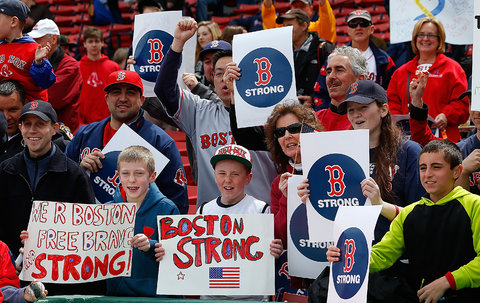
"Boston Strong" became a national slogan by the end of the Boston week. The Boston Athletic Association, which has managed the Boston Marathon since its inception, created a special tee shirt to raise funds for the victims. Details on ordering can be found at: http://www.bostonmarathon.org
Now the long and careful process of trying to find out what the motive was for this murderous crime can begin in earnest. Is this a continuation of the 9/11 terrorism, or is this a new and even more ugly local terrorism carried out by citizens of this country? Brainwashed, filled with hatred for America, just plain crazy...who knows? Hopefully we will have the answers soon. But Patriots' Day and the Boston Marathon will never be the same again. Someone has tried to blacken a wonderful holiday and a wonderful athletic event. But we will not let them succeed. Daniel J. Flynn, writing for The American Spectator had these words for all of us to consider:
Spectators and first responders rushing into the danger zone to aid the bloodied and dismembered victims provoked thoughts of the events that defined the region 238 years earlier. The Minutemen grasped on April 19, 1775 that free isn't. Dozens paid dearly for it. Like the heroes of this Monday past, they didn't anticipate the dangers that enveloped them. A bad situation brought out the best in them. They rose to an occasion they didn't seek.
Certainly 80-year-old Samuel Whittenmore didn't expect a fight to the death when he awoke on April 19, 1775. Yet, before sunset he had killed three redcoats. The reward for his efforts included enduring repeated bayonet strikes and getting shot in the face. About a quarter mile and two centuries from the house in which I grew up, the left-for-dead octogenarian commando arose from a puddle of blood and began to reload his musket.
If you get knocked down, you have a choice: stay in the dirt or stand and fight. When duty calls, whether on the first or last Patriots' Day, patriots act. That's the lesson of April 19, 1775. That's the lesson of April 15, 2013.

At the end of the Boston week, we are Boston strong. That doesn't mean we are ready to gun down any stranger who doesn't look like Tom Cruise. We must not lose our humanity. We will let 8-year-old Martin Richard have the last word. May we all be so fortunate to have these be our last words.


Friday, November 23, 2012

INCH BY INCH, ROW BY ROW


In 1987, I began work on a book to be titled "I Hear New England Singing." It was to encompass as many of the region's singer/songwriters as I could interview. My good friend Jim Harvey would take the photos. For a variety of reasons, the book never got beyond chapter one! But that chapter began a long term admiration on my part for the subject and his amazing musical output. 25 years have passed, and David Mallett keeps turning out brilliantly crafted songs. I'll add an update at the end that will catch you up on what he's done since 1987, but right now (with only a few edits) here's that old chapter one. It was drawn from an October 3, 1987 interview in Dover-Foxcroft, Maine.


My father and I were working in the garden, when it fell out of the sky and landed right between us. I've always wondered what would have happened if Dad had picked it up instead of me. Probably would have thrown it out with the rest of the weeds.
From the stage of Foxcroft Academy, native son David Mallett is telling a packed house how songs are born.

Specifically, he is talking about a special day in the mid-1970s when he received the inspiration for Garden Song, his most widely-appreciated composition to date. And if you doubt that songs fall from the sky and land in gardens, then you have not conversed with enough songwriters. Before the concert, while attending to various details in the Academy locker room, the songwriter in question reflected upon some of the highlights of his career to that point. 

David Mallett, born March 21, 1952, in Dover-Foxcroft, Maine, has been creating words and music that amount to art on a steady basis since about 1972. He echoes the notion of many of his peers that the best songs write themselves. "The music is not me, it's beyond me, and I am fortunate enough to be attached to it."

Over the past decade, Mallett has shared nearly fifty of his songs with us on five well-crafted albums. It was the first of these, David Mallett (produced by fellow Mainer Noel Paul Stookey, who signed Dave to his


Neworld Media label in 1978), that stood the New England folk trust on its collective ear and sent a ripple along the entertainment world's grapevine that eventually reached Colorado's John Denver, then the country's hottest recording artist. Denver adored Mallett's songs and signed him to a publishing contract with Cherry Lane Music, and in 1979 Denver recorded Garden Song (followed by Ballad of the Saint Anne's Reel and You Say That the Battle Is Over in 1980), thus marking the arrival of David Mallett as a "legitimate" songwriter. Just about everyone has since recorded Garden Song, with Tommy Makem & Liam Clancy's rendition being Dave's personal favorite.

Inch by inch, row by row, gonna make this garden grow.
All it takes is a rake and a hoe and a piece of fertile ground.
Inch by inch, row by row, someone bless these seeds I sow.
Someone warm them from below till the rain comes tumblin' down.

David Mallet has lived in Maine all his life, most recently in an old farmhouse near Dixmont. His youth in the small town of Sebec was highlighted (not surprisingly) by music. The local movie house, the radio and the record player provided such lasting influences as Gene Autry, Johnny Cash, and the Kingston Trio. [Ironically, in 1985 Dave was invited to join a trio that included former Kingstons John Stewart and Nick Reynolds.] He cut his musical teeth performing with his older brother, Neil, in the early 1960s. Neil would later sing harmony on his little brother's first album. Remembers Dave: "He played guitar and I sang. And then I got a guitar and he sang harmony, and then we called ourselves the Mallett Brothers, and we toured throughout Maine, a little bit of New Hampshire and the Maritimes. Made a couple singles; had a TV show out of Bangor for a couple of years." 

http://www.youtube.com/watch?v=nomqfR4a6Fk

He had added the influence of Bob Dylan and his contemporaries by the time he went off to the University of Maine, and it was there that Dave came into his own as a singer/songwriter.

Dave holds northern and central Maine dear to his heart and intends to grow old there, although his career ambitions have him heading south again this winter - and probably for many more to come. Nashville has welcomed Mallett with open arms, as it has other folk-style songwriters like Nanci Griffith (from Texas). Noted Country producer Jim Rooney took Dave under his Nashville wing in September of 1985, and the result was Mallett's first non-New England album, Vital Signs.  Will Folk's loss be 


Country's gain? "I've never liked the terms Folk Music, Country Music, Rock Music. I just like Music. And gradually I'm seeing a breaking down of the lines that separate us all, and everybody's influenced by everybody else. It's kinda nice."

Part of the reason for the Nashville move could have been the response to his 1983 album Open Doors & Windows, a brilliant collection of songs (recorded in Massachusetts) that failed to make any new inroads, saleswise. Popular throughout most of New England, Mallett seemed to encounter an invisible wall whenever he tried to gain a more national following. 

So now the bottom line is reaching a broader audience. Dave feels he has ridden the Folk train as far as it can go. "When you get a big campaign going for it, it's not Folk Music anymore. Folk Music likes to be kind of on the back porch, and unfortunately for those of us who make a living with it, that's a disadvantage." He loves Maine but feels impeded by its isolation from the current mainstream of popular culture, and Dave is hard pressed to name more than a few fellow New Englanders (Lui Collins, Patty Larkin, Bill Lauf) whose music he is knowledgeable enough about to comment on. He enjoys the healthy competition of Nashville's songwriting world. In "Music City" his is surrounded by old heroes (like Harlan Howard, John Prine, and Guy Clark), and there he can hopefully peddle songs to other performers as well as perfect his own recording skills. "There's nothing wrong with salesmanship and commerciality, because what I want to do is reach as many people as I can, because I feel like I have something to offer to everybody that listens, and I'm convinced of that just from what fans I do have and the feedback that I've had over the years; what I have given them and what they have given me. And I just feel that in hanging back and dragging your feet and saying 'Oh, I don't want to be commercial; I don't want to sell records,' and all that, you're not doing yourself or the music any good."

Part of the transformation from Folk to Country/Folk is superficial: he was "David" Mallett until Vital Signs, which signaled the official beginning of "Dave" Mallett. Another part may be more far-reaching: his approach to lyric writing is slowly changing, away from topical songs; no more whale saving from Dave Mallett, or at least not for the moment. But one gets the feeling that Country love songs do not flow as easily from his pen as he would like. While the likes of Red Red Rose and Dreamers are a cut above the ordinary, Vital Signs' crowning glories are (Coming Apart) At the Seams, an homage to a James Dean-like school chum who took one too many fast curves, and April, a remembrance of many fine springs as a child in Maine. Indeed, (Coming Apart) At the Seams turned out to be his first "covered" song in Nashville (recorded by Marty Stuart in 1986), and Mallett considers April to be his favorite composition to date. Like many of Dave's better lyrics, the song paints a picture that is intrinsically autobiographical.


April calls you loud and clear
From the middle of the coldest year
A frozen smile, a crystal tear
Are melting in the sun
Across the yard a sudden laugh
And an echo from the hidden path
And all the world's a muddy bath
When old man Winter's done 

I remember April days when a warm wind took the snow away
A robin did a bold display and a gentle crocus bloomed
I was a kicking child of spring
With a will to run and a gift to sing
And a heart that took to wandering
When it heard the wildwood tune 


There will be more great songs on future albums, to be sure. Light At the End of a Tunnel is one that Dave will preview for the home folks tonight. This weekend marks the 65th anniversary of the joining of the towns Dover and Foxcroft, and the song seems appropriate for the occasion, as it was inspired by Dave's grandfather, Will Towne. Will had a favorite workhorse named Blackie that he loved more dearly than just about anything, and Blackie's eventual demise hit the farmer hard. Years later when Will lay on his deathbed, one of Dave's cousins reportedly heard him say that he had seen Blackie at the window and knew that he had come to take him home. The song is about finding a glimmer of hope at death's door. Is is not your typical Country song anymore than Dave Mallett is your typical Country songwriter. One can only hope that the influx of Mallett and others as talented may have more of an influence on Nashville than Nashville will have on them.

Dave's accompanists for the evening's show are Chris Neville (from Boston) on keyboards and Mike Burd (from Maine) on bass, both of whom provided the same assistance on Vital Signs. Dave, as always, plays acoustic six and twelve string guitars, and sings up a storm. Surprisingly, his lyrics seem to come through clearer from the stage than they often do from his recordings.

Dave has lots of other new songs - recorded in Nashville last winter - that are basically ready to release, but he is hoping to sign with a major lable; one that will have the resources to help his songs reach that broader audience he seeks. For a man who is admittedly reclusive and anti-capitalistic, and who was formerly against advertising and hype when it came to his music, this was a difficult decision that took years to reach. But if the ends justify the means, then posterity will be well served. Asked how he would most like to be remembered, Mallett says he hopes he will earn at least a footnote as a "word man," a writer of  "popular music that has meat to it. And that's a tall order." This artist is sincerely serious about his music, and over the years that has translated into ambition.

Dave Mallett straddles the Foxcroft Academy locker room bench, working with a sort of nervous confidence on a set list for tonight's concert, with one foot pointing toward Nashville and the other firmly planted in the soil of his native Maine.

Pullin' weeds and pickin' stones, man is made of dreams and bones.
Feel the need to grow my own, 'cause the time is close at hand.
Grain for grain, sun and rain, find my way in nature's chain.

Tune my body and my brain to the music from the land. 

http://www.youtube.com/watch?v=2m0LewjkO4s

[Lyrics from Garden Song (c) 1977 Old Road Music and Cherry Lane Music Publishing Company, Inc. Lyrics from April (c) 1983 Cherry Lane Music Publishing Company, Inc., ASCAP.]


How did Dave's decade in Nashville work out for him? Well, he did more recording, although he never landed that major label he was aiming for. But his songs got noticed and recorded. Emmylou Harris covered one of his Vital Signs tunes, Red Red Rose.

 http://www.youtube.com/watch?v=nr2NRkguzKg

Dave's follow-up to Vital Signs was 1988's For a Lifetime, again produced by Jim Rooney (and again released on the Flying Fish label). It contained more great Mallett originals, including Summer of My Dreams, which was covered by Kathy Mattea.

http://www.youtube.com/watch?v=WJPk7ckkilo

In all, David Mallett has recorded fifteen albums so far in his career, seven of them since his return to Maine in 1997. From Flying Fish he went to the Vanguard label for awhile in the mid-1990s, then back to Flying Fish when he moved back home for the 1997 album Parallel Lives and 1999's Ambition. In 2003, he got smart and started his own label, North Road Records, based in his current home of Sebec, Maine. His first release was Artist In Me, one of the most acclaimed Folk albums of 2003. That was followed in 2006 by what could be called a "greatest hits: live" album, Midnight On the Water, which is a great place to begin if you are just getting into Mr. Mallett's work. 


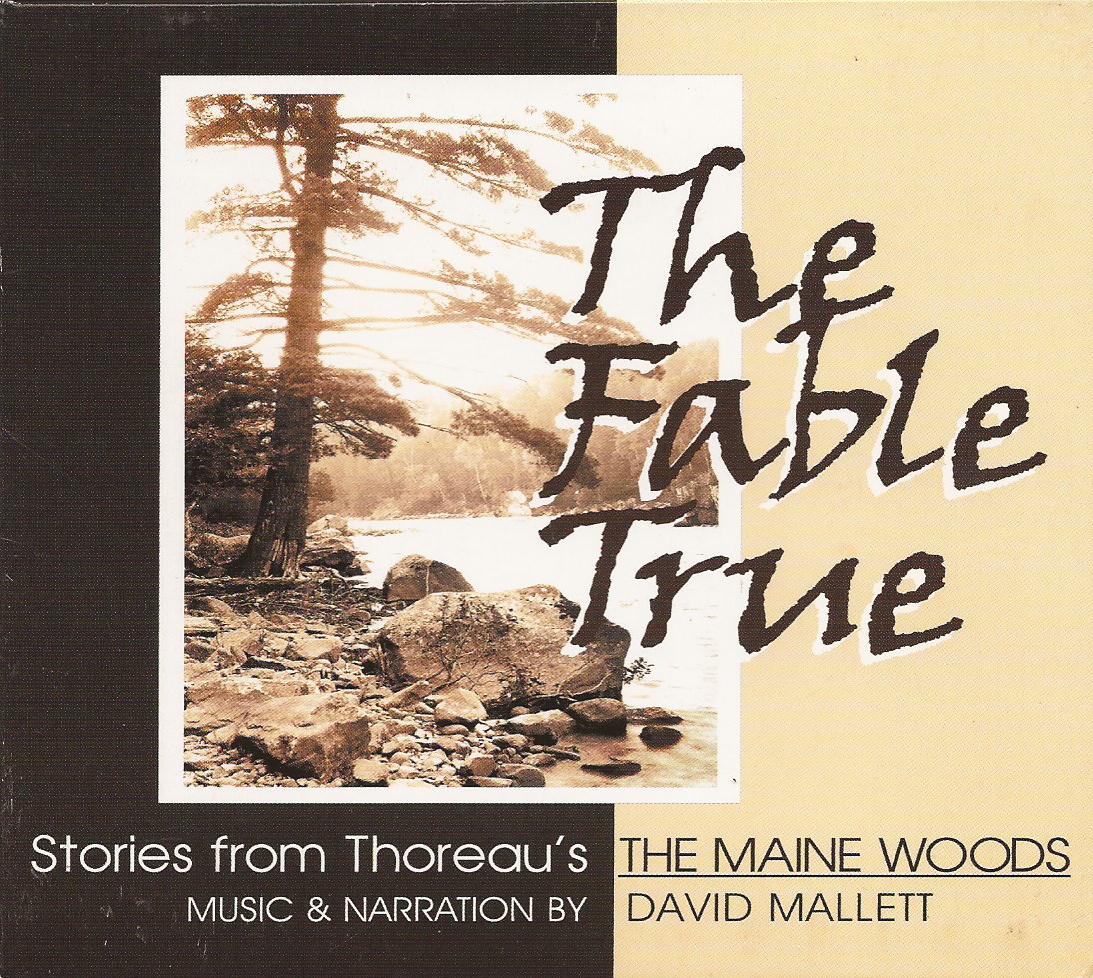
Then Dave took a giant (and somewhat risky) leap into the spoken word recording genre with his 2007 album The Fable True: Stories From Thoreau's "The Maine Woods," for which he provided music and narration for Henry David Thoreau's classic book about his journeys in the Pine Tree State. All of the North Road recordings have featured what has become Dave's permanent band of Mike Burd on bass and Susan Ramsey on violin. Dave's guitar is now constantly accompanied by his wide assortment of harmonicas.


And if anyone thought David Mallett was running out of steam, 2009's release of Alright Now certainly put that to rest in a big way. This is the best album he's ever made, and he's even back to doing the occasional topical song again, with both North Meets South and Ten Men firmly in that category. New instant Mallett classics include Beautiful (written for his daughter), the haunting Dark Side of the Moon, and the slightly fabulous Innocent Time.


After stating at a concert two years ago that his next album would be titled The Horse I Rode In On, a collection of covers of songs that inspired him to get into the music business (he previewed his excellent version of A Tombstone Every Mile by Dick Curless), he has put that on hold and instead recorded an album "in conjunction with the Maine Farmland Trust" titled Greenin' Up, "twelve songs that celebrate farming, the natural world and rural life." He's included a few new songs and fresh versions of some of his classics, like Garden Song, April, and Summer of My Dreams.


It's being released this week, just in time for Lorie and I to pick it up at his December 1 concert at Roaring Brook Nature Center in Canton, Connecticut. It's a yearly ritual that we always look forward to. I'm not sure exactly how many times we've enjoyed a David Mallett concert since 1987, but they've all been great, and he always comes out to shake hands and sign CDs for the faithful after the show. I'm sure it's going to be a first-rate album. Details on all things Mallett can be found on his website:
Or his Facebook page:   http://www.facebook.com/pages/David-Mallett/43762629366?ref=ts&fref=ts

I'm sure Dave would want me to mention that his sons have a band that is really starting to take off with some great reviews and live performances: http://mallettbrothersband.com/


In their millenium edition, the Bangor Daily News listed the "most memorable Mainers of the Twentieth Century," and right there among the names of Andrew Wyeth, E. B. White, Stephen King, and Edna St. Vincent Millay, was... David Mallett!

Mr. Mallett is in a good place right now, creatively and personally. This statement on his website says it all: When he is not touring, the place where he makes his songs is in his writing room in an old farmhouse with a view across the field and a tintype of his great-great grandfather on the wall. "I like to keep reaching out to touch the past," he says, "to connect it with what's going on now. To me music is one of the few things that's timeless...human emotion is one continual chain."


Special thanks to David Mallett, Mike Burd, and Jim Harvey.

Portions of this blog originally appeared in The Piscataquis Observer.